
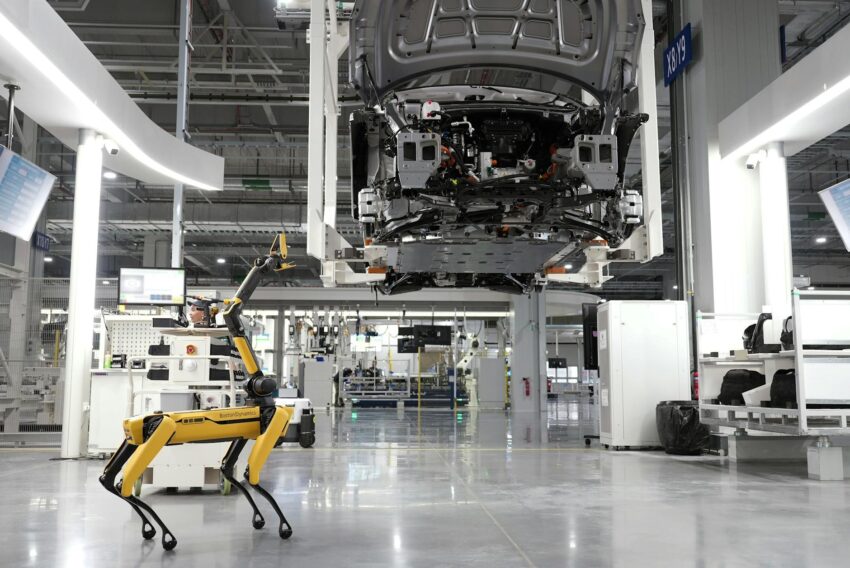
As technology continues to revolutionize the way we live and work, the industrial sector is experiencing a significant shift. Recent advancements in artificial intelligence (AI), coupled with robotics, are poised to redefine manufacturing as we know it. Recent comments by Jensen Huang, the CEO of Nvidia, underscore this change: “The ChatGPT moment for robotics is here.” With smart machines taking center stage, The Economist has taken a closer look at the so-called “factories of the future” and what they signify for the global economy.
The Evolution of Automation
Historically, manufacturing and automation have been synonymous with manual labor and repetitive tasks carried out by machines. However, the latest advancements in AI are empowering these machines with unprecedented intelligence and agility. Factories are no longer just physical structures filled with assembly lines; they are evolving into sophisticated ecosystems that leverage big data, connectivity, and deep learning algorithms. This dramatic evolution is encapsulated in the phrase "smart manufacturing."
A Tour of Tomorrow's Factories
In a recent episode of the Money Talks podcast, hosts Ethan Wu and Alice Fulwood took listeners on a journey through Germany, a country known for its engineering prowess and innovation in manufacturing technology. They were joined by Anjani Trivedi, The Economist’s global business correspondent, who emphasized that Germany leads the charge in adopting intelligent manufacturing solutions.
Trivedi pointed out that these “factories of the future” harness AI-driven robots that can not only perform tasks but also learn and adapt based on real-time data. This means that production lines can become more flexible and responsive to consumer demand, reducing waste and improving efficiency.
Implications for the Workforce
As machines become more advanced, the human workforce must evolve alongside them. There is a growing concern that increased automation may lead to job displacement. Nonetheless, experts argue that while some roles may become obsolete, new opportunities will emerge in more technologically driven positions. The key will be to focus on reskilling and upskilling the workforce to enable workers to thrive in this AI-enhanced landscape.
Trivedi made a point that the challenges also bring new potential. For example, positions related to maintaining, programming, and managing these advanced systems are likely to see increased demand. Companies and governments will need to invest in education and training programs to facilitate this transition.
The Global Economic Landscape
The shift towards AI in manufacturing does not just affect individual companies or workers; it has broader implications for the global economy. Nations that adapt quickly to these changes may find themselves at a competitive advantage. Advanced manufacturing capabilities could alter trade dynamics, create new supply chains, and allow countries to innovate in sustainable practices.
Moreover, AI and robotics can contribute to economic growth by enhancing productivity levels, which could lead to reduced costs for consumers. However, the transition period bears risks as traditional manufacturing jobs may decline, challenging existing economic structures.
The Road Ahead
As we continue to explore the potential of AI in manufacturing, the conversation must also consider ethical implications. Issues surrounding data privacy, job security, and the role of human workers in a tech-driven ecosystem must be thoughtfully navigated.
While the path to smart factories is fraught with complexities, the benefits are too significant to ignore. The integration of AI into manufacturing can lead to unprecedented efficiency, better resource management, and a more responsive manufacturing sector.
The future may be uncertain, but the transformation of manufacturing stands to usher in a new era characterized by technological advancement, creativity, and perhaps most importantly, an opportunity for a reimagined workforce.
For more insights into this transformation, tune into the latest episode of Money Talks here.
Conclusion
The conversation around AI and manufacturing is just beginning. The potential effects, both positive and negative, are vast and complex. As we look toward “factories of the future,” it is crucial that stakeholders—including businesses, governments, and educators—collaborate to shape an industry that is not only efficient and innovative but equitable and sustainable for all.
Stay tuned for more updates and analysis as the evolution of manufacturing unfolds.